Spurs fans have been discussing former midfielder Mousa Dembele after he announced his retirement from international football this week.
The 32-year-old confirmed in an interview with Belgian news outlet HLN (via LastWordonSpurs) that he would be hanging up his boots for Belgium due to fitness and injury issues. The former Fulham midfielder played 249 times for the Lilywhites in his spell with the North London club, before making the move to China to join Guangzhou R & F in January 2019.
Dembele’s best season for Spurs probably came in the 2015/16 season, where he averaged a superb 7.69 rating for his performances in the Premier League, with injuries perhaps affecting his form in later seasons. With Spurs midfielders Harry Winks, Tanguy Ndombele and Eric Dier having all struggled for form so far this season, it is no surprise to see several fans commenting on the post that they miss the Belgian in their midfield.
The K-League, Korea’s professional football league, has opened a media facility that will be the central hub for the production of its live matches and other content.
The league has invested KRW1bn (€738,500/$838,000) in the media centre, which is located in Magok District, in Gangseo-gu, Seoul.
The centre will relay live broadcasts of matches produced by broadcasters or other production companies, to domestic and international broadcasters and digital platforms.
The centre will also give the league capabilities including an artificial intelligence-powered video editing system, the ability to create uniform screen graphics for league match coverage, the ability to provide subtitles and commentary in Korean and English, and a digital archive of K-League content. Archive material was previously stored on video tape.
The AI video editing system will be used to quickly create content for social media, and other channels.
The league studied similar facilities built by the German Bundesliga, in Cologne, and the Japanese J.League, before building its own.
Work on the facility began in July last year, and it was unveiled to the media last week.
The Sports Chosun website reported that Cho Yeon-sang, secretary general of the K-League, said: “The media centre that we created is very similar to the Bundesliga in Germany. Through the establishment of this media centre, we can expect the internationalisation of K-league broadcasting and various uses of game videos.”
Sportradar is working closely with the league in developing a comprehensive commercial strategy to enhance its global distribution and coverage for its media and digital rights. An invitation to tender covering media and betting streaming rights over the next five seasons was launched by the K League in July.
In August last year, coverage of the K League became available once again in China after an agreement was reached with K-Ball, the online streaming service of Win Power, a subsidiary of the China Sports Media agency.
If you fancy yourself as the next David Beckham, Elton John or perhaps petro-state royalty then you’re in luck. You, too, can become the owner of a top-flight football club.
Chinese Super League side Tianjin Tianhai are up for sale. Well, that’s not quite right, the 2018 AFC Champions League quarter-finalists are actually available for free. Nothing. Gratis.
The Tianjin Football Association said last week it will transfer the rights to whoever can take them on, with several companies reported by local media as being interested.
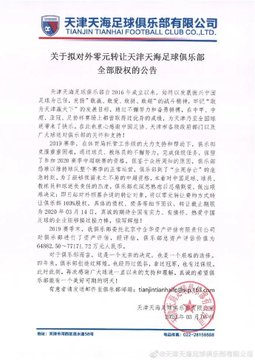
“The club have reached a critical moment and in order to maintain the hard-fought position in the Chinese Super League, have, after careful considerations, made a difficult decision,” read a statement on the club’s official social media channels. “We will transfer 100% of the club with zero fee.”
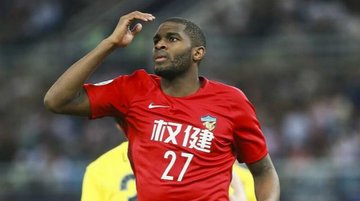
Tianjin Tianhai officially announced they are looking for a buyer, who could take the club for free, whose estimated value is between ¥647.72m to ¥771.71m($93.4m to$111.3m). But the club may have huge debt. In addition they are still in a legal dispute with Anthony Modeste.
There is a catch to getting a club that was valued at some 700 million yuan (US$100 million) for nothing. They come in the form of a reported US$145 million debt, although how much any new owner would be liable for was “negotiable”.
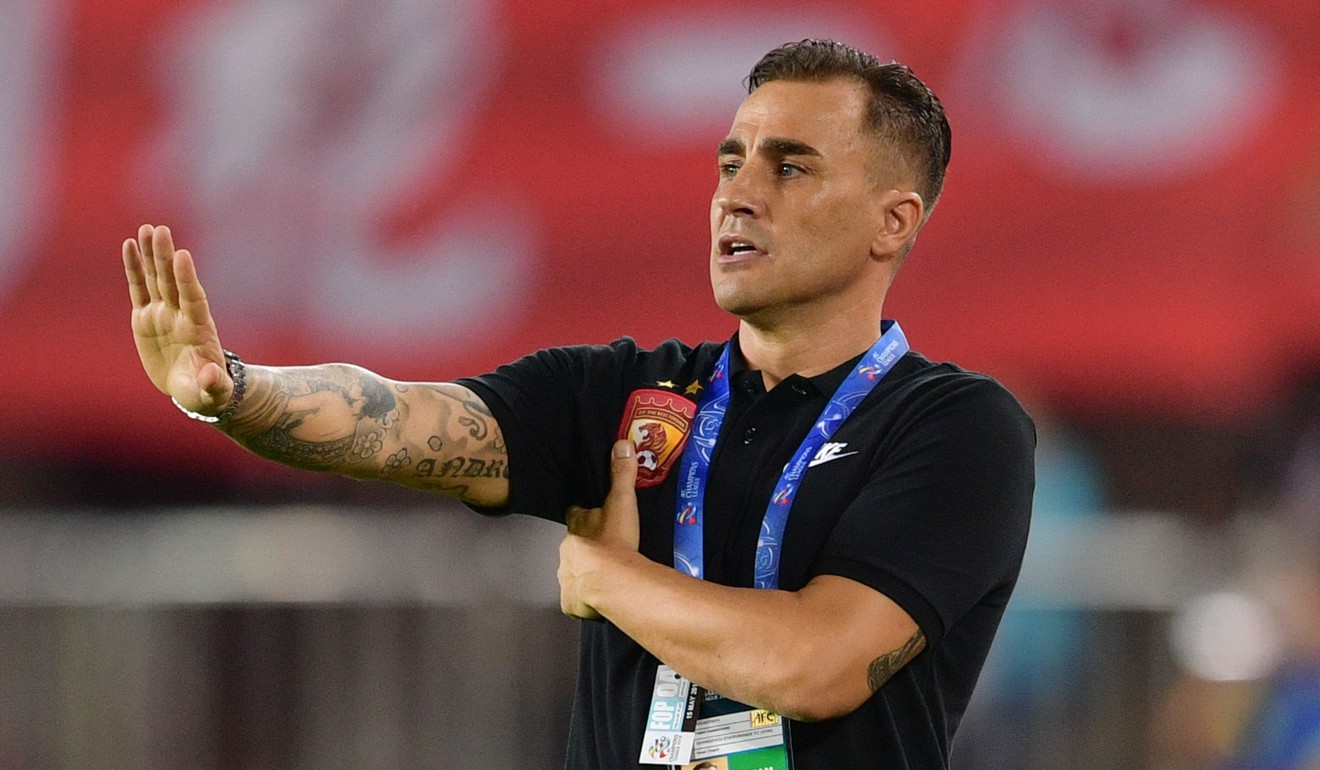
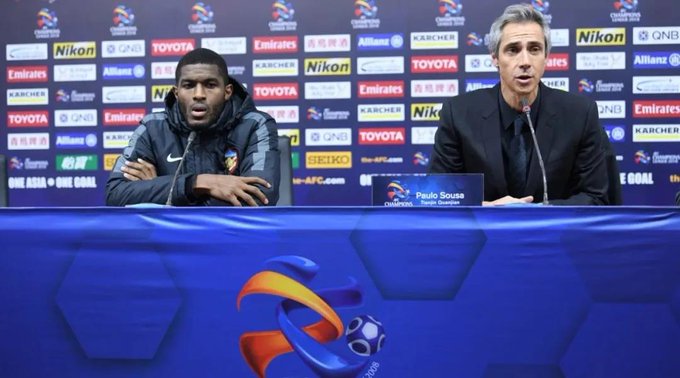
There are also several disputes hanging over the club with former coaches and players seeking payouts, including Fabio Cannavaro, Paolo Sousa and Anthony Modeste, who returned to German Bundesliga side Cologne amid claims of contract breach.
Former head coach Fabio Cannavaro in charge of Guangzhou Evergrande. Photo: AFP
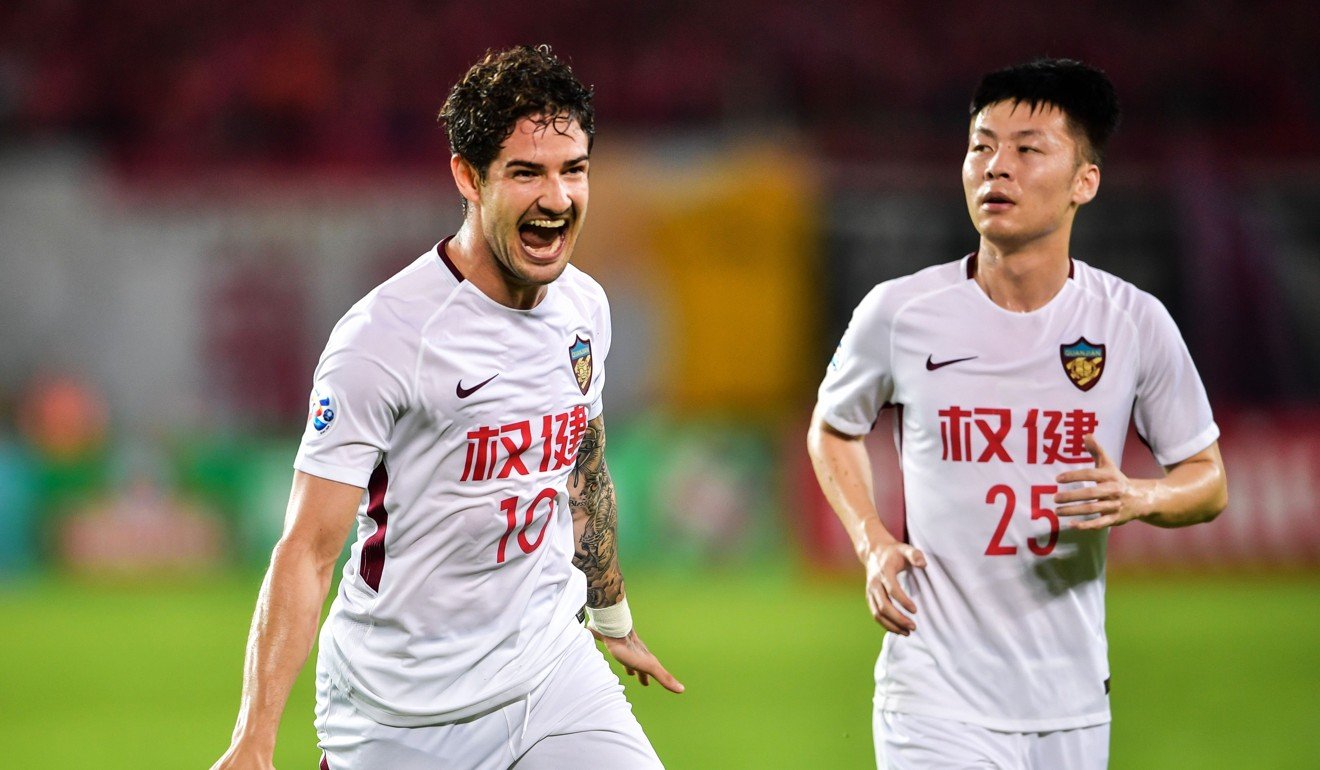
These are hangovers to some extent of the freewheeling days when the club was called Tianjin Quanjian and owned by pharmaceutical giant Quanjian. Chairman Shu Yuhui’s fall from grace ended in a nine-year prison sentence for a pyramid scheme and the club’s days of attracting players like Alex Pato and Axel Witsel was over.
The Tianjin FA stepped in, renaming the club Tianhai, last season. Now they understandably want someone else to foot the bill.
Though Tianjin Tianhai are free for sale, there are huge amount of debts for the buyer to clean off. According to Chinese media, Tianjin Tianhai are accused of owing salary by former employees, including Choi Kang-hee, Vanderlei Luxemburgo, Paulo Sousa & Anthony Modeste.
This is made all the more complicated by the Chinese Football Association’s request that the club file papers with them to prove they can play (and more importantly pay) over the coming two seasons. The deadline to file is 5pm on Thursday, February 12, while the club’s own deadline to find a “buyer” has a deadline of a day later.
There may be a last-gasp reprieve from either one of the interested parties – although time is tight – or the CFA itself, given that there is no Chinese Super League to play, with the new season postponed indefinitely amid the coronavirus fight.
Coach Li Weifeng was confident enough to dismiss rumours that the side would not be in the CSL next season after staying up in 2019.
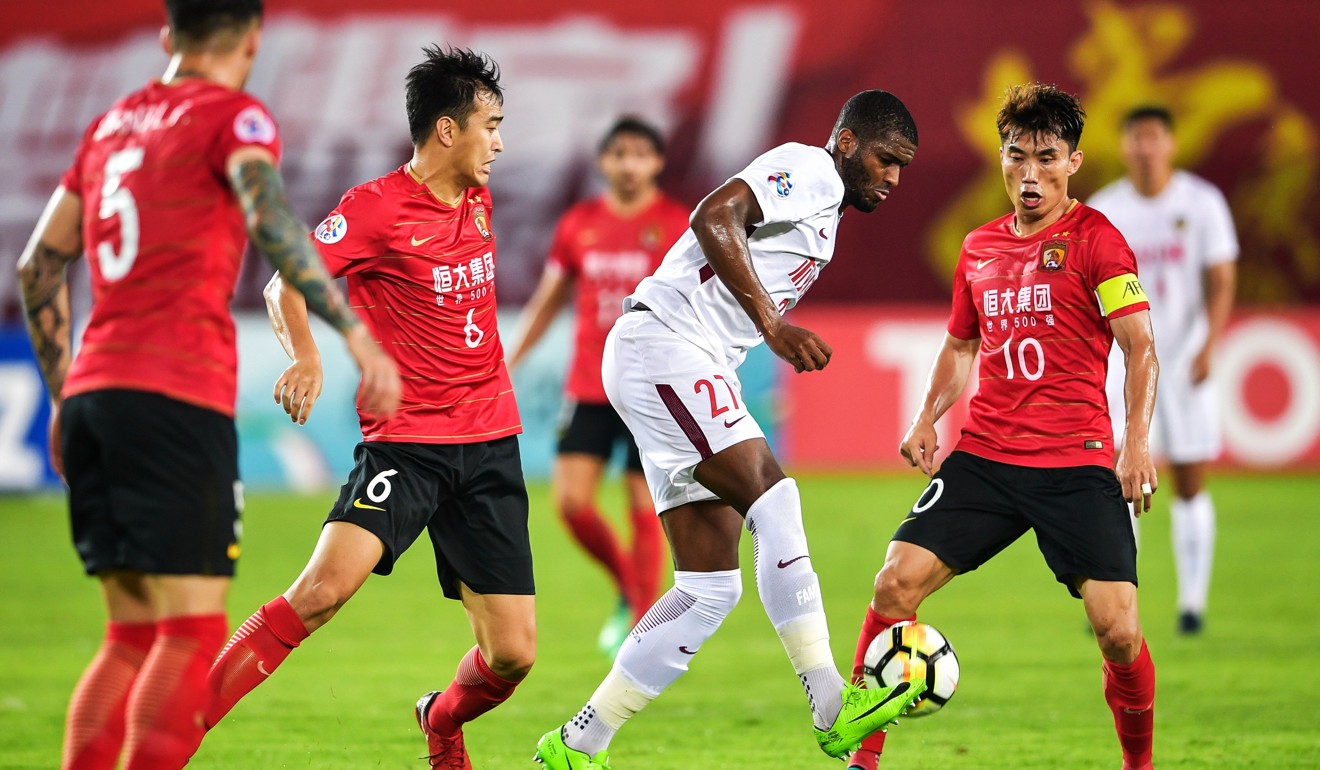
Tianjin Quanjian’s Anthony Modeste in the AFC Champions League. Photo: AFP
“Such rumours are very irresponsible and disrespectful to the players who tried so hard last season,” the former Everton defender told Tencent Sports. “The club is facing some problems, but they can be solved.
“And some are questioning why we did not sign new players. There’s no rule that a team must sign somebody during a transfer window.”
Tianhai have lost 13 players in the close season – eight of them expired loans – while no new recruits have come in.
“Every team has its own troubles, that’s normal. That doesn’t mean the club has no future,” Li said, noting that Tianhai’s situation was different to other clubs where players have gone unpaid.
Pato celebrates another goal. Photo: AFP
Still, Friday the 13th could be a nightmare for Tianjin Tianhai. More worryingly, the true horrors for Chinese football could be yet to come.
While it is unusual for teams in the CSL to risk disappearing completely, the same cannot be said for China’s lower leagues.
Stalwarts Liaoning Whowin are also in trouble and looking for a new owner, while the list of clubs that have left the league since the start of last season stands at nine – three in League One and six in League Two. None could prove they had fully paid players and staff in 2019. The futures of another three clubs are reported to be in doubt.
It is expected that Shenzhen, who were relegated from the CSL last season after finishing four points behind Tianhai, will replace them. Coupled with Liaoning’s expected demise, Sports Weekly reported that the CFA asked six League Two teams to prepare the documents to move to League One. The second tier was meant to expand to 18 teams from 16 this season, but instead teams are dropping like flies.
The large amounts of wages and taxes owed in the second and third tier has damaged the foundations of the professional football pyramid.
How did it come to this? The financial frenzy at the top end of the league forced everyone to spend to keep up and that went down the leagues.
Chinese footballers are paid well over the odds in China, where only a limited number of foreigners are allowed. That – and the money paid to foreigners, some of whom are among the top earners in the world – means that clubs spend fortunes with little commercial revenue in return.
Huge transfer fees were curbed by introducing a transfer tax and other rules have followed in an attempt to curtail spending and make clubs operate within their own means, but it is too little, too late.
It has all hit the medium-term goal of football’s 2015 action plan, “the professional league organisation and competition level has reached the top in Asia”.
That, like a future for Tianjin Tianhai, seems a long way off.
During the 2019 J1 League season, FC Tokyo came tantalisingly close to securing their first-ever league title. However, Kenta Hasegawa’s side just ran out of steam and Yokohama F. Marinos were able to finish with a six-point lead over the Tokyo club.
This term, an opening day 3-1 victory over last season’s 12th-placed Shimizu S-Pulse could have been a signal of intent that the side from the Ajinomoto Stadium mean business this term and intend to go one better than their second-place finish last year.
Every major stat in their opening game of the season went the way of the opposition, with less possession (36% to S-Pa’s 64%), far fewer passes (300 to 547), a lower pass accuracy (72% to 86%) and marginally fewer shots at goal than their opposition (12 to 14). However, as the adage states, it is the sign of a good side to play poorly and to win.
So, this tactical analysis will shed some light on whether FC Tokyo are just another pretender to the throne this season or if they are to be 2020’s true heir. This scout report will highlight some of Hasegawa’s key tactics and use analysis to explain their impact.
A change in formation
One of the key and most obvious changes to have been noted in Hasegawa’s side from last season to the beginning of this is a change in formation. Last term, the Tokyo side predominantly deployed a 4-4-2 formation, although also a 4-2-2-2 on occasion, however, have so far this term rolled with a 4-3-3 structure. This has led to several key patterns of play emerging in their first J1 League game of the season which have been brought on by the structure change. The majority of these are seen in how the side attack.
How FC Tokyo looked in attack last season with a 4-4-2 structure
In this annotation, how the side looked in attack last season, with the 4-4-2 structure can be seen. This, taken from the 4-2 victory over eventual title winners Yokohama F. Marinos, shows how the two wide midfielders in the midfield four looked to get as high and as wide up the pitch as possible, making the structure like a 4-2-4 while in possession, a common theme in 4-4-2 formations. However, this season the entire structure of the attack has altered, which may, in part, be due to 18-year-old starlet and right midfielder, Takefusa Kubo, departing the club for Real Madrid last August.
FC Tokyo’s 4-3-3 structure against Shimizu S-Pulse
Here, the annotation taken from the 3-1 victory over Shimizu S-Pulse can be seen. Two of the key features being Brazilian pair Leandro, number 20, and Adailton, number 15, who arrived at the Ajinomoto Stadium during the offseason. Leandro, on the left-wing, and Adailton, who was moved further forward when right-winger Kyosuke Tagawa was substituted off, played key roles in the front three.
The interchanging front three
What was most noticeable about the front three of Leandro – Diego Oliviera – Tagawa, which later changed to Leandro – Oliviera – Adailton, was how fluid and interchangeable they were, which was key in FC Tokyo picking up three points. As opposed to rigidly sticking to their left-wing, centre-forward and right-wing roles, the trio would interchange where appropriate which made the attackers hard for S-Pa’s defenders to mark and ultimately was crucial in the victory.
One way in which the front three interchanged
Here, we see the front three in their starting positions, Leandro on the left, Oliviera centrally and Tagawa on the right, however, as the move developed one way in which the three interchanged becomes apparent. At this stage, Oliviera has dropped deep to flick the ball on to a fellow attacker, which sets the two wingers moving, however, instead of creating width, the pair move centrally to make the attack narrow.
Just before FC Tokyo win a penalty for their equaliser
Now, with Leandro having latched onto the flicked-on header, Tagawa continues his run across from the right into the central area, which then drags across the defenders as marked by the orange arrows. Due to the defenders shadowing the run of Tagawa, space opens up towards the back-post area of the box, to where Oliviera runs across the path which the right-winger has run to find the free space and he is left unmarked. However, in the end, Leandro is fouled, and Hasegawa’s side is awarded a penalty.
Punishing counterattacks
Another strength that the introduction of the front three, as opposed to a front two, coupled with the interchanging movement of the trio, is make FC Tokyo punishing on the counterattack. At least that was the case in their victory on the opening day of the season. Again, having enjoyed just 36% of the possession, it was the potency of the front three which allowed the side to claim three points.
FC Tokyo on the counterattack
Here, one of FC Tokyo’s counterattacks can be seen, from which the home side bagged their second goal of the afternoon. In this case, Leandro is attacking centrally, Oliviera from the right and Adailton is coming from the left-hand side. In the annotation, we can see a similar pattern of play to when Oliviera had dropped deep to win the header, with the two attackers that are out wide making runs into central areas, again looking to increase the difficulty in marking them.
Seconds before Adailton bags his goal
As seen previously with the run from Tagawa, Oliviera makes the run from the right-hand side across the face of goal which sees the defending players mirror the run, as marked by the orange arrows, which opens up space behind them. Adailton senses the space and makes his run from the left-hand side to the right across the path of where Oliviera has come from. The ball then finds its way into the path of Adailton, who is able to fire past Neto in S-Pa’s goal unchallenged.
Hasegawa’s introduction of a central pivot
What the switch to a 4-3-3 from a 4-4-2 has also enabled Hasegawa to do is to introduce a clear central pivot role which was key in the side’s out of possession structure and linking the defence with the midfield. While the key elements to FC Tokyo’s set-up were seen in their attack and how the 4-3-3 had influenced that, the pivot role was vital in retaining the side’s solidarity, which was key with the opposition enjoying large swathes of the ball with 64% possession.
FC Tokyo’s pivot role when in possession
The man charged with performing the pivot role for FC Tokyo has been 26-year-old Kento Hashimoto, who has been with the Tokyo club since 2012. As can be seen in the annotation, when the side was in possession, Hashimoto would drop much deeper than the other midfielders to provide support to the two central defenders and bridge the gap between defence and midfield. This also allowed the two full-backs to move higher and wider, almost being level with the two midfielders to create a midfield four.
Hashimoto’s role when out of possession
In this annotation, we can see Hashimoto’s role when FC Tokyo were out of possession. When the home side was without the ball, the structure would look a lot more like a 5-3-2, which the pivot role was vital for as Hashimoto would join the defensive line while an attacker would join the midfield to keep a middle three. This was a key tactic for the home side in maintaining their solidarity and will likely be a key feature over the 2020 season.
Conclusion
As stated early on in the piece, what has been key for FC Tokyo so far in 2020, is their switch to a 4-3-3 from a 4-4-2 which has seen completely new patterns of play emerge in their game. As Hasegawa’s side fell just short of being champions last season, perhaps the change in structure will be the detail which turns the balance in their favour.
The two attacking patterns of play in the interchangeability of the three forwards and their potency on the counterattack due to this seem as though they will likely be ever-present features across 2020 for FC Tokyo if they stick with the 4-3-3 set-up. The introduction of the central pivot also appears as though it will likely be a key feature for Hasegawa’s side, all of which could be vital if the side is to go one better than last year.
Either way, it will certainly be an interesting one to watch unfold and to find out if the change in FC Tokyo’s structure from last season will be as decisive as it could potentially be.
My name is Andrew and this year I completed my degree in Football Journalism at the University of Derby with first-class honours. For my sins, I support Oldham Athletic.