quinta-feira, 12 de setembro de 2019

Is Ole Gunnar Solskjaer delivering on his Man Utd promise?

When Man Utd hit rock bottom last season, Ole Gunnar Solskjaer vowed to bring about change - but has he?
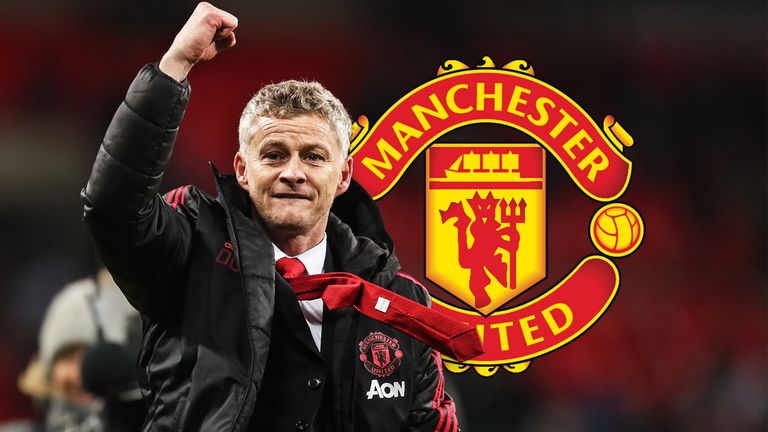

Ole Gunnar Solskjaer appeased disgruntled Manchester United fans at the end of last season with the guarantee that change was coming. Jack Wilkinson examines whether he has been able to deliver on that promise...
It was the result that signalled the start of Manchester United's dismal demise at the end of last season.
Ole Gunnar Solskjaer's sensational start - 10 wins and a draw from his first 11 games - became nothing more than a distant memory by the time Theo Walcott rattled in Everton's fourth goal to complete a humiliating defeat on Merseyside.
Gary Neville labelled the performance at Goodison Park "rancid" and, after apologising to the travelling United fans unfortunate enough to be there in person, Solskjaer promised change - wholesale change.
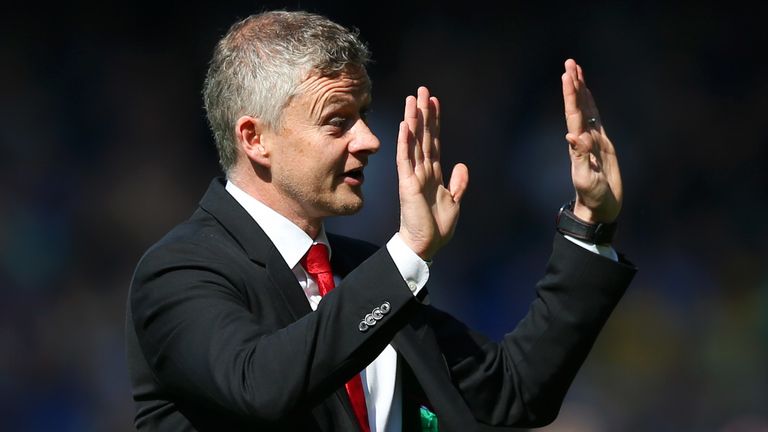
I am going to be successful here and there are players who won't be part of that.

Ole Gunnar Solskjaer
It was a steely statement of intent straight out of the Sir Alex Ferguson textbook and, five months on, the manner in which Solskjaer has gone about transforming United suggests it's a promise he will honour.

Wholesale change

Before the ink had even dried on his first Manchester United contract in 1986, Ferguson was already barking out orders. Then-chairman Martin Edwards was informed of the Scot's wish to sign as many as eight players, and Viv Anderson, Brian McClair and Steve Bruce were signed within 18 months of his arrival.
That decisiveness in the transfer market appears to have rubbed off on Solskjaer.

Man Utd summer transfer activity 2019

InOut
Daniel JamesRomelu Lukaku
Harry MaguireMatteo Darmian
Aaron Wan-BissakaAnder Herrera
Antonio Valencia
James Wilson
Chris Smalling (loan)
Alexis Sanchez (loan)
Joel Pereira (loan)
Players deemed no longer fit for purpose have been shown the door by any means necessary. Whether it be the sales of Romelu Lukaku and Matteo Darmian, the departures of Ander Herrera and Antonio Valencia, or the financing and pushing through of loan deals for Alexis Sanchez and Chris Smalling - there's a ruthless edge to United's dealings.
One thing Solskjaer has yet to master, though, is the ability Ferguson had time and time again throughout his reign at Old Trafford to adapt his playing style to suit new personnel and remain competitive.
0:29
Cole: Man Utd still a few years away
Former Manchester United striker Andy Cole says the club are still some way off being able to challenge Manchester City and Liverpool for the title.

Work in progress

After the humbling defeat at Everton, Solskjaer set out the fundamental principle he wants to define his time at United. "I want my team to be the hardest working team in the league," he said. "That is what we were under Sir Alex."
While that addresses Solskjaer's initial concerns over his squad's work-ethic, it's hard to see how that translates into the visible shift in playing style United fans have been yearning for.
United's first four Premier League games this season, and their final four last season after the defeat at Everton, give very little indication as to what he will settle on, other than the fact that it is very much still a work in progress.

Man Utd's last four PL games 18/19

Man CityChelseaHuddersfieldCardiff
Duels won42504752
Goals conceded2112
Possession36.851.764.273.6
Possession won in final third5322
Interceptions106815
On the one hand, United have enjoyed more possession, won more duels, conceded fewer goals, and run an average of 106.9km per game - all positive signs that Solskjaer's philosophy is being implemented.
On the other, an alarming drop in both interceptions and winning the ball high up the pitch suggest it's going to take time for the squad to successfully juggle their manager's demands.

Man Utd's first four PL games 19/20

ChelseaWolvesPalaceSo'ton
Duels won55675770
Goals conceded0121
Possession46.365.671.358.6
Possession won in final third4023
Interceptions12567

A precious commodity

And time, ultimately, is what will determine Solskjaer's chances of success - time. Will he be given the time to see out the project he has started?
Ferguson famously got time, six-and-a-half years until he won his first league title, but it's a precious commodity in the modern game. Results have rightfully clouded judgement on United's start to the season, but progress, however slim, is being made on the pitch to go with the much-needed dressing room reset Solskjaer promised.
"It does take time," Neville said. "Not just to actually get people in the dressing room all facing the same direction, but to get the quality in that's needed.
0:46
‘United need to stick with their process'
Jamie O'Hara believes Manchester United must give Ole Gunnar Solskjaer time to make a serious impact at Old Trafford.
Manchester United must give Ole Gunnar Solskjaer time to carry out his process of change at Old Trafford, says Jamie O’Hara.
"It took Pep Guardiola 12 months, three transfer windows. It's taken Jurgen Klopp three or four years to affect the culture at Liverpool and get a team fully in what he would say is his style, his culture and what he wants to do.
"This is going to be a long game at Old Trafford. To play the long game, Solskjaer is going to need the support from up above. He's going to need really strong leadership over the next two or three seasons to be able to have those four or five transfer windows that he needs."
United are on their fourth clean slate in the seven years that have passed since Ferguson's retirement. After the outcome of the previous three under David Moyes, Louis van Gaal and Jose Mourinho, Solskjaer's tenure is one that's working but must be given time to restore the club to where they feel they belong.

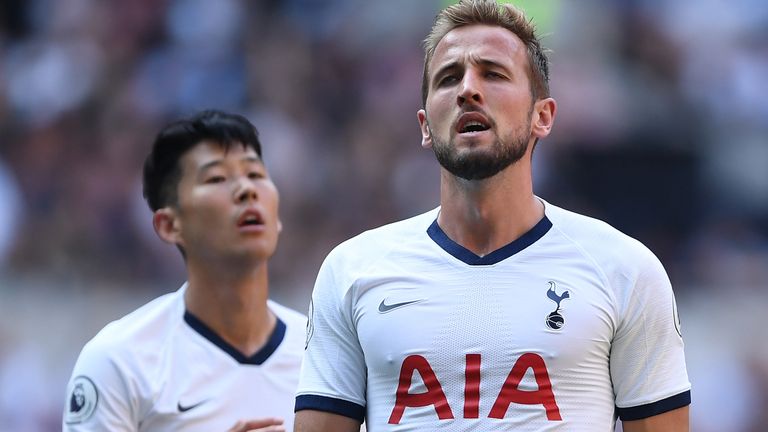
Tottenham's pressing problem: Is Mauricio Pochettino changing their approach this season?

Tottenham's pressing has been a feature of their progress under Mauricio Pochettino, but they have done things differently lately


UEFA's newly-published technical report is full of interesting insights into last season's Champions League, but there is one statistic that stands out particularly strongly.
According to its findings, more than half of the goals scored in the competition - 185 out of 366, to be exact - came from possession regained in the opposition's final third.
It is an eye-catching detail which reflects the growing prevalence of pressing at the highest level of the game. The report specifically highlights the "extraordinary intensity" of Liverpool's press in their semi-final second-leg win over Barcelona. But Jurgen Klopp's men were not the only ones to profit from forcing mistakes high up the pitch.

The final, when Liverpool faced Tottenham, was billed as a meeting between two of the best exponents of high pressing. Curiously, though, Spurs went on to record their lowest number of pressures in any Champions League game all season, with 64. By way of contrast, Liverpool's Mohamed Salah accounted for 34 pressures on his own.

An anomaly or a trend?

What felt like an anomaly at the time - Spurs had recorded more than twice as many pressures in their semi-final second leg against Ajax a few weeks earlier - now feels like the beginning of a trend. At a time when high pressing is becoming increasingly prominent elsewhere, recent evidence suggests Spurs are moving in the opposite direction.
So far this season, the high press simply hasn't been there. Sky Sports pundit Gary Neville described Spurs as "lethargic" during their 2-2 draw with Manchester City last month. They were similarly flat in the 1-0 loss to Newcastle a week later. And while they did counter-attack at speed against Arsenal last Sunday, their pressing game was still oddly absent.
Unai Emery's side were able to build from the back more-or-less unchallenged at the Emirates Stadium, which was especially surprising given the obvious problems Liverpool's high press had caused them in their previous game. Klopp's side won possession in the final third 13 times at Anfield. At the Emirates, Spurs only managed it twice.
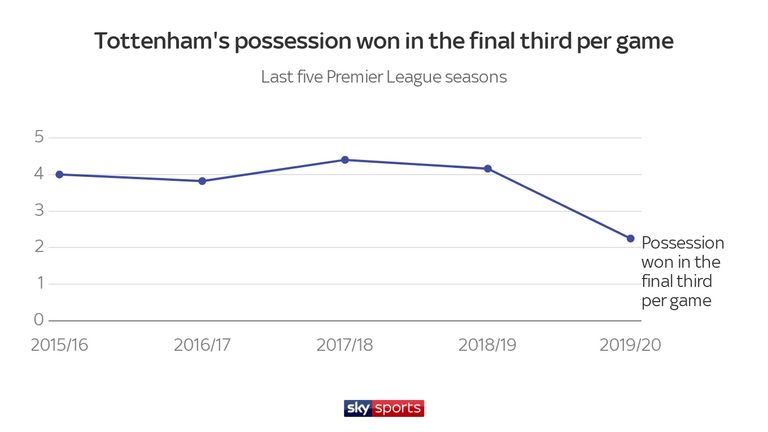
In fact, Spurs have only won possession in the final third nine times in four games all season, putting them 16th among Premier League sides. Their average of 2.3 per game represents a considerable drop-off on their usual numbers. Last season, they averaged 4.2 per game, putting them fifth. In 2017/18, their average of 4.4 per game put them third.
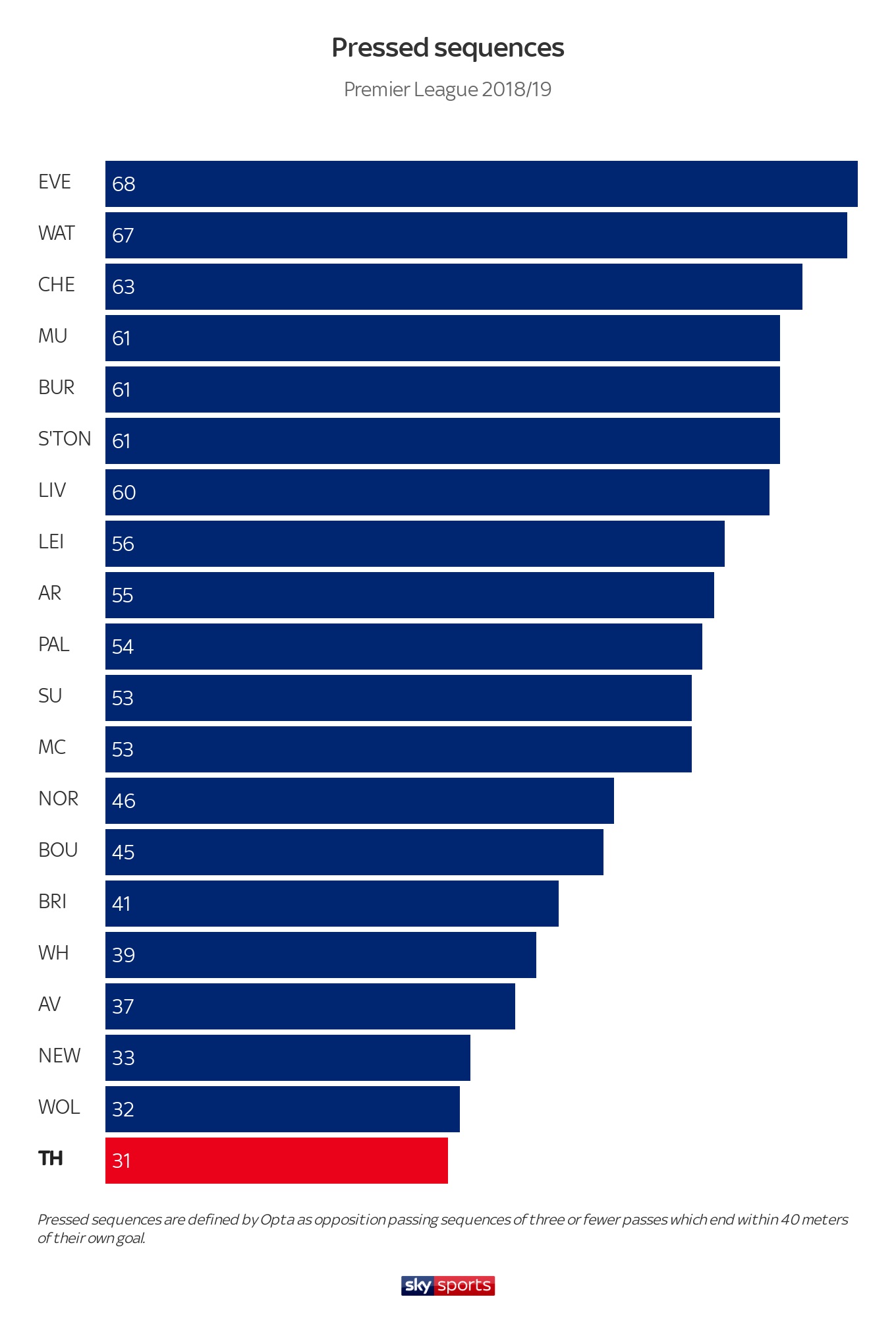
Opta's data for pressed sequences is even more revealing. Pressed sequences are defined as opposition passing sequences of three or fewer passes which end within 40 meters of their own goal. This season, Spurs have forced fewer pressed sequences (31) than any other Premier League side, averaging 7.8 per game compared to 13.2 last season.
It is a small sample size, of course, but it is still alarmingly out of character for a side whose aggressive pressing was once a hallmark. It is not so long ago that returning Watford manager Quique Sanchez Flores was comparing Mauricio Pochettino's players to "animals" for the speed and determination with which they hunted down possession.

Concern for Pochettino

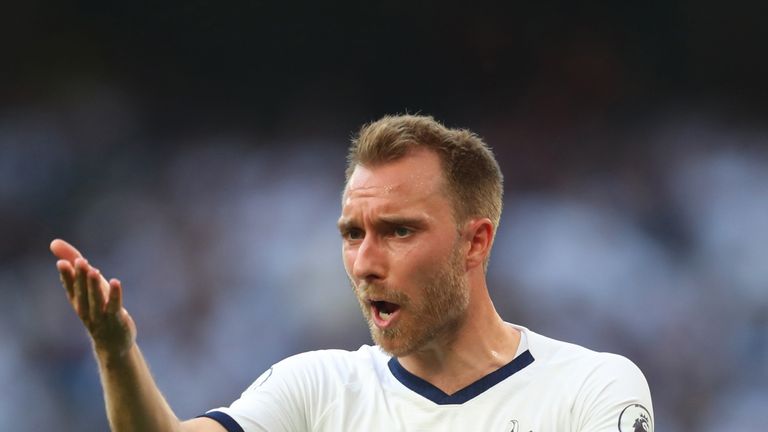
Christian Eriksen was linked with a Spurs exit during the summer
So what's happened? If it is a deliberate strategy, then it is not working. Spurs have survived away trips to Manchester City and Arsenal this season, taking five points from their first four games, but the lack of off-the-ball urgency has seen them give up a worrying number of chances. Only Aston Villa have faced more shots. Only Norwich have faced more shots on target.
It is also clear that the issues have been a source of frustration to Pochettino. He has cut a disgruntled figure since the Champions League final, complaining that his squad is the most "unsettled" it has ever been since his arrival at the club and alluding to its impact on the team's performances - specifically their pressing - after the Arsenal game.
"We need togetherness," he said. "The team wasn't settled and I told you from day one of pre-season that I wasn't happy. The most important thing is to all be on the same page and that the players have a clear idea of how we need to move."
An effective press requires total commitment from every player, it requires team spirit and focus. But with Christian Eriksen's mind elsewhere, with Jan Vertonghen mysteriously losing his place in the side and with new signings still bedding in, those factors have not been there. Tottenham's cohesion has taken a hit and recent evidence suggests their pressing has too.

Kane conundrum

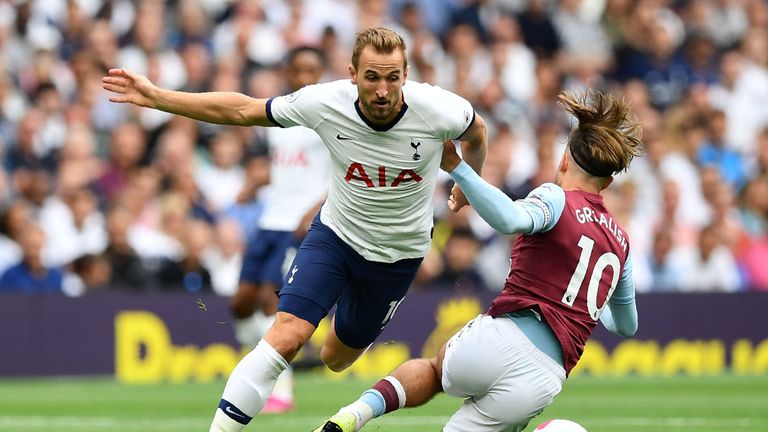
Harry Kane is played every minute in the Premier League this season
Pochettino hopes the closure of the transfer window - coupled with a pause for the international break - will allow Spurs to get their rhythm back. But a high-pressing approach requires a striker to set the tone. Is Harry Kane still that striker? Is he still suited to playing in a high-pressing system?
It is a conundrum for Pochettino. There can be no questioning Kane's attacking contribution. He has scored seven times for club and country in the opening month of the season alone. But in the last few years he has suffered a string of ankle injuries and his game is evolving as a result.
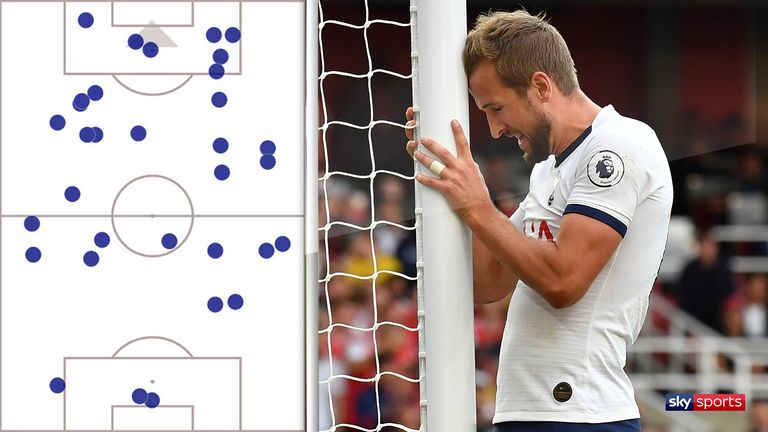
Kane is still at his most dangerous in the opposition's penalty box, but these days he is just as likely to be seen dropping deep as he is playing on the shoulder of the last defender. Instead of running in behind himself, he now prefers to vacate the space for his team-mates to take advantage.
Harry Kane's touchmap from Tottenham's 2-2 draw with Arsenal shows how the striker is dropping deeper
Kane's evolution has impacted his off-the-ball work, too. This season, he is averaging fewer ball recoveries and fewer attempted tackles than in any of his previous six campaigns with Spurs. So far this season, he has only won possession in the final third twice in 360 minutes on the pitch.
A player who once led the press for Pochettino is no longer playing with the same intensity, and it is perhaps no coincidence that, the last time Spurs produced the kind of breathless pressing they have become known for under Pochettino - in that Champions League semi-final second leg against Ajax in May - Kane did not feature at all.
His return to the starting line-up for the final was a welcome boost for Spurs, but as UEFA's technical report tells us, their intensity suffered.

What now for Tottenham?

Perhaps Pochettino is still hoping that Kane will get back to his old intensity levels. There was encouragement in how he won possession in the opposition half in the build-up to England's third goal against Bulgaria on Saturday. He then created another opening for Raheem Sterling in similar circumstances against Kosovo on Tuesday.

But the Premier League is an altogether more taxing environment. Kane's evolution suggests he knows his attributes are changing and Tottenham's adjusted approach this season suggests Pochettino knows it too. A side whose progress has been driven by high-pressing tactics must find a new way forward. For now, it remains a work in progress.

Big guns fire in last 32 first legs

Lyon, Wolfsburg, Bayern, Twente, Barcelona and Slavia were among Wednesday's first-leg winners.

First legs

Wednesday 11 September
  • Ada Hegerberg's Lyon hat-trick moves her to 47 European goals, one ahead of Marta and behind only Anja Mittag (51) and Conny Pohlers (48).
  • Lyon's Wendie Renard, Wolfsburg's Pernille Harder (the 2018/19 top scorer) Slavia's Tereza KožÔrovĆ” and Twente's Fenna Kalma also got first-leg trebles.
  • Mandy Islacker scored twice for Bayern including deep in added time.
Thursday 12 September
  • All seeded teams are the home sides in the second leg except Fiorentina, whose tie with Arsenal has been switched
  • Lyon have won the title four years in a row and six times overall, both records
  • Wolfsburg and Arsenal (ending a five-year absence) are the other former winners involved while Barcelona, Paris and Fortuna are past finalists
  • BrĆøndby are in the knockout rounds for a record 16th time; they, Fortuna and Lyon have featured in all 11 seasons of the round of 32 under this format
  • PiteĆ„, Lugano and Chertanovo will make their debuts in this round while fellow newcomers Braga came through the qualifying round
  • Albania (Vlllaznia) and Kosovo (Mitrovica) are represented in the round of 32 for the first time
  • Anderlecht are also making their knockout bow after knocking out 2018/19 quarter-finalists LSK Kvinner, and now face fellow qualifying round graduates BIIK-Kazygurt.

Second legs

Wednesday 25 September
BIIK-Kazygurt v Anderlecht
Lyon v Ryazan-VDV
Wolfsburg v Mitrovica
Fortuna HjĆørring v Vllaznia
Slavia Praha v Hibernian
Barcelona v Juventus
Twente v St. Pƶlten
Bayern München v Göteborg
Manchester City v Lugano
Thursday 26 September
Brøndby v PiteÄ
Sparta Praha v Breidablik
Zürich v Minsk
Atlético Madrid v ŽFK Spartak
Arsenal v Fiorentina
Glasgow City v Chertanovo
Paris Saint-Germain v Braga

Road to Vienna

Round of 16 draw: 30 September, Nyon
Round of 16: 16/17 & 30/31 October
Quarter-final & semi-final draw: 8 November, Nyon
Quarter-finals: 24/25 March & 1/2 April
Semi-finals: 25/26 April & 2/3 May
Final (Viola Park, Vienna): 24 May